What normally takes trekkers three to four days to cover on foot, trail runner and architect Sannat Sachdev completed in just 12 hours and 12 seconds—a 52.5-kilometre journey from the Bir landing site to the remote village of Bada Bhangal, deep in the Dhauladhar Himalayas.The journey, completed on September 18, was the culmination of a six-year dream that began after Sachdev settled in Bir in 2020. Originally from Jaipur and trained as an architect, Sachdev gradually made the mountains his home, taking up trail running and eventually turning it into both his sport and profession as a coach.The route began not from Rajgundha, as is more commonly associated with the approach to Bada Bhangal, but from Bir’s landing site, making the crossing significantly longer and more demanding.
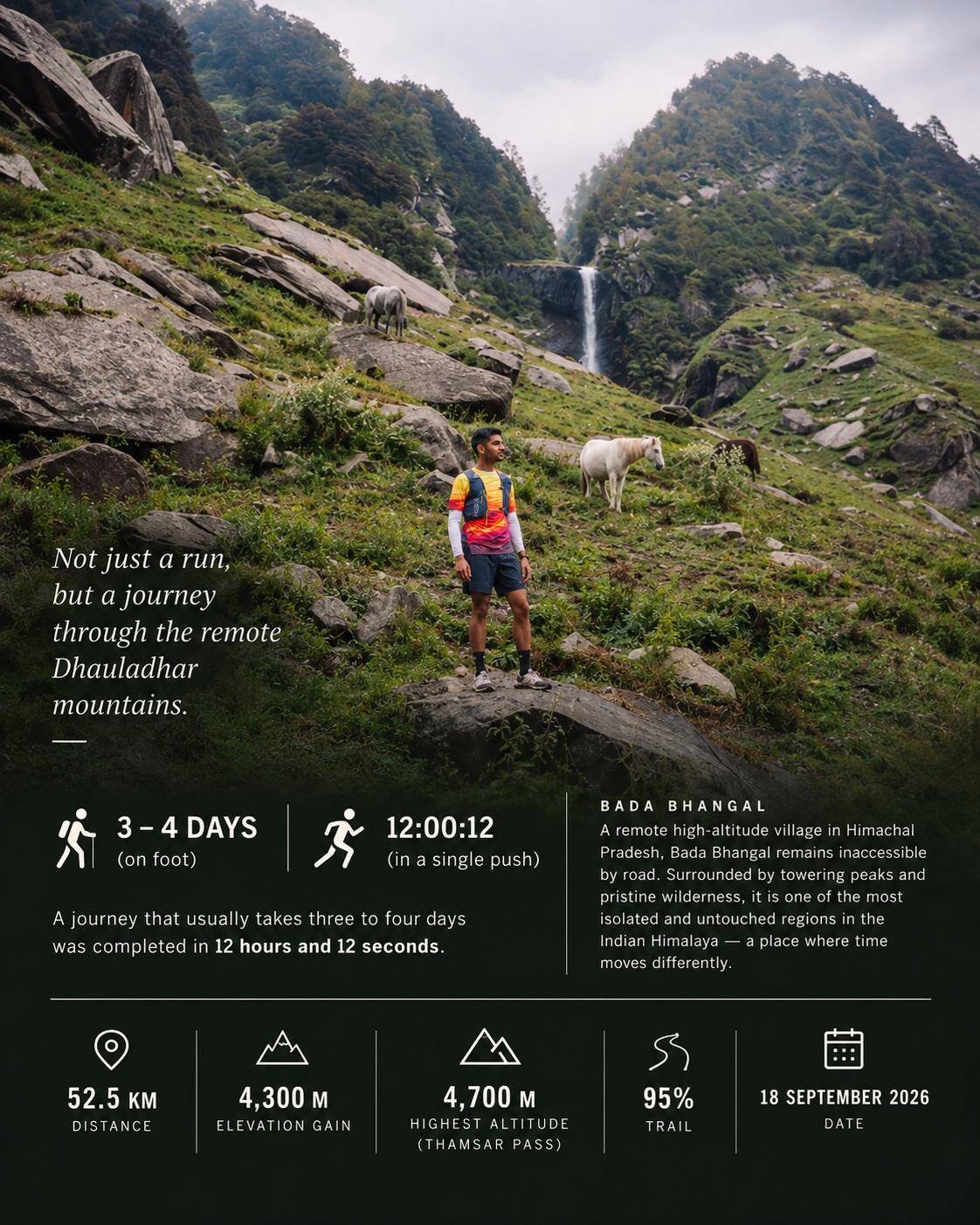
A six-year dream culminates in an extraordinary journey from Bir’s landing site to one of Himachal Pradesh’s most remote villages, crossing the Thamsar Pass at 4,700 metres
Over the course of the journey, Sachdev covered 52.5 kilometres with approximately 4,300 metres of elevation gain—equivalent to climbing more than four vertical kilometres over the course of a single run. Around 95% of the route was on trails, taking him through forests and remote mountain terrain via Mandher, Thathi Jot, Rajgundha, Plachek, Jhodi and Panihartoo before reaching the Thamsar Pass at approximately 4,700 metres.The route presented conditions far removed from conventional road running. It involved technical mountain trails, river crossings, landslides, glaciers and steep, exposed terrain. At the Thamsar Pass, fresh snow made the descent particularly challenging, forcing Sachdev to negotiate sections where simply staying upright became a greater challenge than running.After reaching the pass, the final section involved an approximately 15-kilometre descent dropping around 2,200 metres into Bada Bhangal. What would ordinarily be an opportunity to run quickly became one of the most technically demanding portions of the journey, with snow and loose terrain making progress slow.
A six-year dream culminates in an extraordinary journey from Bir’s landing site to one of Himachal Pradesh’s most remote villages, crossing the Thamsar Pass at 4,700 metres
Sachdev had set himself a target of completing the entire crossing in under 12 hours.He eventually reached Bada Bhangal in 12 hours and 12 seconds.“For six years, I had this idea in my head of running from Bir all the way to Bada Bhangal in one day. Most people I spoke to couldn’t really imagine it being possible, and honestly, that was part of what made me want to try it,” says Sachdev. “This isn’t about running fast on a trail. It is about moving through an incredibly remote and challenging landscape under your own power, making decisions constantly, managing your food and water, dealing with altitude and terrain, and keeping moving when things don’t go according to plan.”For Sachdev, the significance of the journey extends beyond the distance or the time taken. Trail running remains a relatively unfamiliar sport in India, particularly when compared with road running. Unlike road races, trail running takes athletes into natural and often remote environments, where the terrain itself becomes one of the biggest challenges.In this case, the route crossed some of the most rugged terrain of the Dhauladhar range, culminating in Bada Bhangal—a remote Himalayan village with no conventional road access.
A six-year dream culminates in an extraordinary journey from Bir’s landing site to one of Himachal Pradesh’s most remote villages, crossing the Thamsar Pass at 4,700 metres
“When you tell someone you ran 52 kilometres, they can understand the distance. But 52 kilometres in the mountains is a very different proposition” Sachdev explains. “There were sections where I couldn’t run at all. There was fresh snow, there were landslides, river crossings and extremely technical terrain. At 4,700 metres, even moving efficiently becomes difficult. So the achievement isn’t simply the number of kilometres—it is being able to navigate the entire landscape continuously for 12 hours.”The journey was also supported by a team of friends and members of the Bir community, who helped with logistics and encouragement along the way.For Sachdev, however, the journey did not end with reaching Bada Bhangal.“The two days afterwards, staying in Bada Bhangal, disconnecting from the network and simply living slowly in the village, were actually some of the most memorable moments of the entire experience” he says.Having spent the last several years building his life and work around the mountains, Sachdev hopes the project will also help introduce a wider Indian audience to trail running as a sport—not simply as trekking or running on a dirt road, but as a demanding endurance discipline that combines physical fitness, mountain skills, navigation, resilience and a deep engagement with the landscape.Project at a glanceRoute: Bir Landing Site → Bada BhangalDistance: 52.5 kmElevation gain: ~4,300 mHighest point: ~4,700 m — Thamsar PassTime: 12 hours, 12 secondsTrail: ~95%Terrain: Technical mountain trails, forests, river crossings, landslides, snow/glacial terrain and steep descentsFinal descent: ~15 km / ~2,200 m elevation lossNormal journey: Approximately 3–4 days on footDate: 18 September 2026.