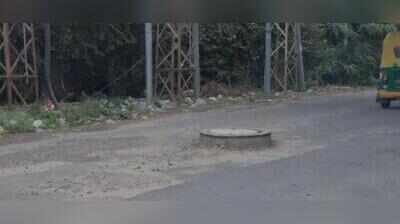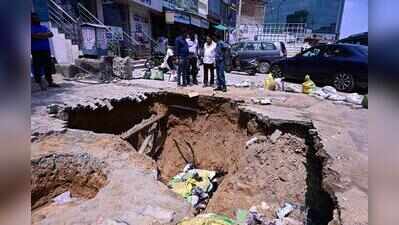
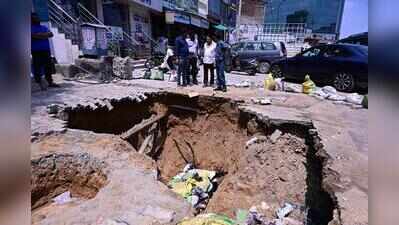
Jaipur: A single night of heavy rainfall highlighted critical flaws in Jaipur’s road infrastructure, with numerous cave-ins reported throughout the city Monday morning.A significant sinkhole, nearly 20 feet deep, opened on Sirsi Road, while two sections of the roadway connecting Shipra Path and Gurjar Ki Thadi along the Dravyavati River suffered collapses. In one instance, almost 10 feet of the roadway caved in, endangering commuters.Additional collapses were reported near the Chordiya petrol pump in Sanganer, where a small truck became lodged in the damaged area. Other affected locations include Kiran Path in Mansarovar, road near Khirni Phatak in Jhotwara, and outside the Ganga Jamuna petrol pump near New Atish Market.Urban planning and civil engineering experts attributed the extensive damage not just to the rainfall but to years of poor construction practices, inadequate drainage systems, and subpar quality control beneath the road surface.Former Town Planner Chandra Shekhar Parashar said, “Road failures begin long before the monsoon. After excavation, the soil is often not compacted properly, and leaking water from pipelines or drains gradually creates underground cavities.” Parashar added that the trend of sub-contracting projects to inexperienced contractors and prioritising quick payments over quality has substantially shortened the lifespan of city roads.Experts said proper road building involves a sequence of engineering checks rather than just laying an asphalt layer. It begins with testing the soil’s bearing capacity, followed by careful earthwork and layer-by-layer compaction using mechanical rollers and vibratory compactors—an essential process involving 150-200 mm incremental layers. Every stage must meet engineering standards before subsequent layers, including the sub-base, wet mix macadam (WMM), base course, and bituminous layers, are applied. Additionally, creating proper road camber, side slopes, and continuous drainage are crucial for directing rainwater away and preventing seepage beneath the pavement.Former MNIT professor BL Swami said, “Water is the biggest enemy of roads. If the camber is incorrect or roadside drains are missing, water seeps beneath the surface and weakens the soil. Simply resurfacing roads without improving drainage only postpones the problem.” Swami highlighted Haldighati Marg in Pratap Nagar, where efficient drainage largely mitigated waterlogging issues.Former Town Planner HS Sancheti pointed out that Jaipur’s sandy soil exacerbates its vulnerability to sinkholes. “Even a small underground void can quickly develop into a major sinkhole. Poor coordination among various agencies often results in roads being dug up repeatedly and trenches not being restored correctly,” Sancheti said.Experts suggested that most sinkholes do not occur suddenly and are the result of gradual soil erosion caused by leaking sewage, stormwater, and water supply pipelines—an occurrence known as suffosion. This process creates hidden voids underneath the surface.Without a commitment to scientific construction practices, stringent quality checks, and long-term maintenance, experts warned that road cave-ins like those experienced due to Sunday night’s heavy rainfall are likely to continue during the monsoon season.