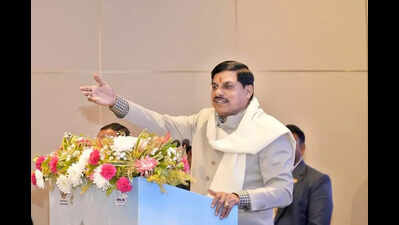
Jaipur: As the country’s technology investment map expands beyond traditional hubs such as Bengaluru, Hyderabad and Pune, tier-II cities are emerging as the next engines of growth, a senior Madhya Pradesh official said Sunday.Chief Minister Mohan Yadav, in Jaipur, to pitch the state as a preferred destination for IT and ITeS, global capability centres (GCCs), semiconductors and data centres at the TiE Global Summit, said it was the responsibility of state govts to create an ecosystem that retains local talent and integrates it into the state’s growth and development.“South India led the IT sector for years. Now the landscape is changing,” Yadav said, pointing to Madhya Pradesh’s progress through investor-friendly policies and targeted incentives. He cited the hospitality and healthcare sectors as examples, where investors committing Rs 100 crore are eligible for subsidies of up to 30%. “The state is also working on a policy under which private investors setting up medical colleges will receive 300 beds, doctors, paramedical staff and medicines at the govt’s expense. In addition, 25 acres of land will be provided at a token cost of Rs 1,” Yadav said.Elaborating on the IT ecosystem, Sanjay Dubey, additional chief secretary, department of science and technology, Madhya Pradesh, said policies were tailored to the specific needs of different segments of the industry. “For instance, since data centres are power-intensive, the govt offers a Rs 2 per unit power rebate. Capital expenditure subsidies of up to 40% are available for semiconductor units, stackable with central incentives, while GCCs can avail support of Rs 1 lakh per employee per month to facilitate relocation of local talent,” he said.Highlighting advantages such as talent availability, and improved quality of life, Dubey said future expansion in IT and digital services would increasingly be driven by tier-II cities. “Nearly 15% of the workforce currently employed in large metros comes from tier-II towns, many of whom are keen to return closer to home if comparable opportunities are available,” he said.