Jaipur: Investigators are examining multiple factors that may have contributed to the Delhi-Mumbai Expressway crash in Dausa that killed eight people after a sleeper bus collided with a trailer, causing both vehicles to catch fire.The probe is focusing on whether commercial cargo intensified the blaze, whether driver fatigue played a role, whether the trailer was sufficiently visible, if the stretch was properly lit, and whether shortcomings in the road environment contributed to the collision.
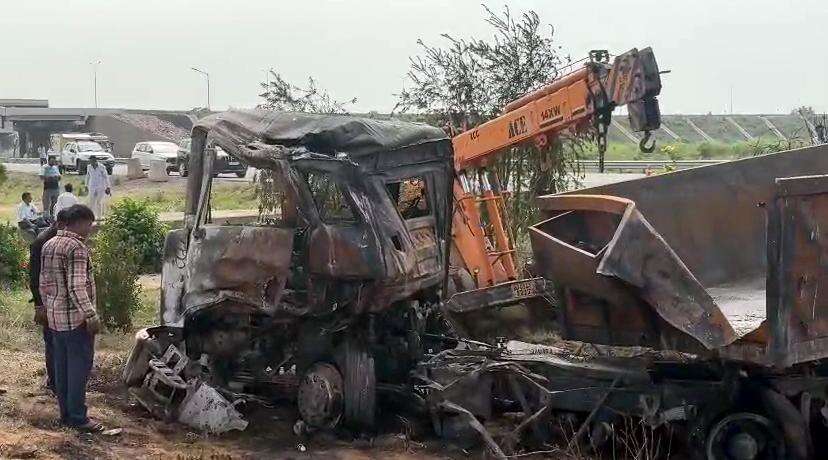
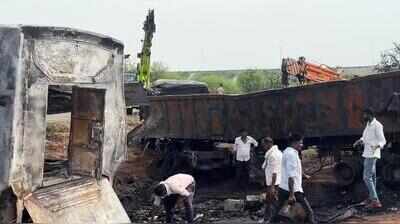
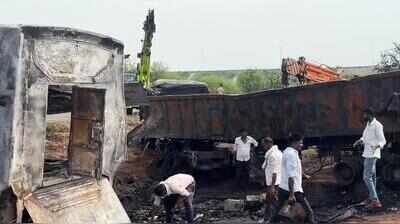
Dausa [ Rajasthan], Jul 01 (ANI): A view of charred remains after a bus traveling from Haridwar to Indore lost control and caught fire after colliding with a trailer in the Kolwa police station jurisdiction on the Delhi-Mumbai Expressway, in Dausa on Wednesday. (ANI Video Grab)
Police are probing claims by local residents that cartons of cigarettes were found in the bus’s luggage compartment after the crash.Experts said that even if cartons of cigarettes were present, the cigarettes themselves would not be expected to ignite spontaneously.Investigators are examining whether the bus driver, after spending hours behind the wheel, experienced fatigue before the collision. An eyewitness told TOI that there were two drivers and that another driver had taken over at Kashmere Gate in New Delhi.“We have seen similar rear-end crashes on this expressway where drivers either react too late or fail to react altogether. In this case, however, we cannot confirm that yet,” an official said.Investigators are also scrutinising the crash site, including to check if the loop near where the accident occurred lacked adequate lighting and warning signboards, potentially causing drivers negotiating the section at night to become disoriented about the road alignment, resulting in delayed reactions or sudden braking.While the truck driver has been detained for questioning, investigators are also examining whether the sleeper bus had functional emergency exits.The Dausa district collector has constituted a joint inquiry committee, while police said the final findings would depend on forensic examination, vehicle inspections, Integrated Road Accident Database (iRAD) analysis and mechanical inspection reports.“We will ask the bus company whether it had provided a second relief driver for such a long route,” an official said, adding that investigators would also examine whether the trailer complied with mandatory illumination and visibility requirements.“The trailer was reduced to a metal skeleton in the fire, but it has to be determined whether the mandatory reflective markings and lighting were in place. Poor conspicuity of heavy vehicles is a recognised cause of night-time expressway crashes,” another official said.Experts said a high-speed rear-end collision can rupture a bus’s diesel tank, fuel lines or engine components. Although diesel is less volatile than petrol, it can ignite when atomised and sprayed onto hot engine or exhaust components, or when exposed to electrical sparks or friction-generated heat, sustaining an intense blaze.They added that foam seats, mattresses, curtains, plastic interior panels, PVC flooring and wiring insulation commonly used in sleeper coaches can rapidly produce dense toxic smoke and accelerate the spread of flames. Once enough combustible material ignites, the passenger compartment can undergo flashover, leaving occupants only a few minutes to escape.They added that foam seats, mattresses, curtains, plastic interior panels, PVC flooring and wiring insulation commonly used in sleeper coaches can rapidly produce dense toxic smoke and accelerate the spread of flames. Once enough combustible material ignites, the passenger compartment can undergo flashover, leaving occupants only a few minutes to escape.