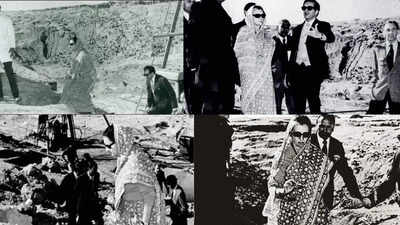
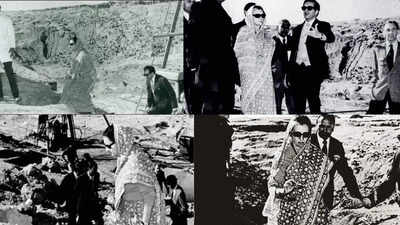
JAISALMER: The land that first placed India among the world’s nuclear-powered nations still remains largely forgotten. Even after 52 years, no government has made any serious effort to preserve the history of this significant moment for the country. Former Rajasthan Chief Minister Vasundhara Raje had announced in her 2018 Budget speech that a grand memorial pillar would be built in Pokhran to commemorate India’s first nuclear test. However, after the change in government, the proposal never materialised. At the same time, this historic event also transformed the fortunes of Jaisalmer. It marked the beginning of the city’s rise on the global tourism map. After inspecting the nuclear test site, former Prime Minister Indira Gandhi visited the historic Patwon Ki Haveli and Diwan Nathmal Ki Haveli in Jaisalmer and directed that these heritage structures be preserved. Tracing the site of India’s first nuclear test conducted on May 18, 1974, and reaching the location with the help of local villagers, it became evident that very few people were even aware of this historic place — the very land whose tremor once shook the world. In the scorching 47-degree heat, this correspondent travelled nearly 140 kilometres from the district headquarters to the Malka village area near Loharki village, located within the Army’s field firing range. Witnessing the historic site filled one with immense pride. The site that helped India emerge as a nuclear power lies inside the Pokhran Field Firing Range, where entry is permitted only with official approval. At the dry well in Malka village, where the first nuclear test was carried out on May 18, 1974, a massive crater and raised earth formations still silently narrate the story of that historic moment. Although the Army has fenced the area within a radius of nearly 500 metres, nowhere is the story of this achievement displayed, nor has any memorial been built to tell future generations that this is the land that enhanced India’s prestige and strengthened national pride. Fifty-two years ago, Buddha Purnima — May 18, 1974 — became a historic day for India and a memorable day for the people of Jaisalmer. It was on this day that India laid the foundation for its entry into the league of nuclear powers through the Pokhran nuclear explosion. When scientists pressed the button at the Loharki test site, the blast echoed across the world and placed Pokhran firmly on the global map. India’s first nuclear test astonished the world. While Prime Minister Indira Gandhi described it as a “peaceful nuclear explosion”, the United States responded by halting supplies of nuclear materials and fuel to India. According to reliable sources, all preparations for the nuclear test had been completed by May 18. A watchtower had been erected five kilometres away to monitor the explosion, from where senior military officials and scientists observed the proceedings. Scientist Virendra Sethi was sent for the final inspection of the test site. However, after completing the inspection, his jeep failed to start. Since the explosion was scheduled for 8 am, time was running out, and Sethi had to walk nearly two kilometres back to the control room. Due to the unexpected delay, the test timing was postponed by five minutes. This top-secret project had been underway for years. A team of 75 scientists and engineers worked relentlessly from 1967 to 1974. The project was led by Dr Raja Ramanna, Director of BARC. Among his team members was A. P. J. Abdul Kalam, who later led the Pokhran nuclear tests in 1998. In 1972, during a visit to the Bhabha Atomic Research Centre, Prime Minister Indira Gandhi verbally authorised scientists to develop the nuclear test device. Until the day of the test, the entire operation remained highly confidential, and even the United States failed to detect it. Angered by the development, the US imposed restrictions on nuclear material and fuel supplies, while the Soviet Union extended support to India during the difficult period. Elderly villagers living near the first nuclear test site still vividly remember the events of May 18, 1974. They recalled that the sudden explosion caused tremors that cracked the walls of their homes. The blast, equivalent to 12 kilotons of TNT, created a massive cloud of dust that rose into the sky before gradually dispersing. Villagers also recalled that after the explosion, illnesses affecting livestock, women and children were reported in nearby areas. Former BJP district president of Pokhran, Jugal Kishore Vyas, recalled that he was 23 years old at the time and was sitting at the Dak Bungalow when he suddenly felt what appeared to be an earthquake accompanied by a loud explosion. Initially, people believed that the Army had conducted a routine test in the Pokhran range. It was only after Prime Minister Indira Gandhi made the official announcement that they realised India had successfully conducted its first nuclear test. Vyas further said that after the nuclear explosion, skin-related ailments and other illnesses were reported among women and children in nearby villages. However, although a team from the Bhabha Centre in Mumbai tested water samples from the area, no radioactive contamination was officially detected. He added that to commemorate and preserve this historic achievement, former Chief Minister Vasundhara Raje had announced the construction of a grand memorial pillar in Pokhran in her 2018 Budget speech, but the project could not move forward after the government changed. At the same time, this historic event also changed the destiny of Jaisalmer. It marked the beginning of the city’s emergence on the global tourism map. After visiting the nuclear test site, Prime Minister Indira Gandhi came to Jaisalmer, toured Patwon Ki Haveli and Diwan Nathmal Ki Haveli, and envisioned promoting Jaisalmer globally as a tourism destination. She also directed that these heritage structures be conserved. Thus, May 18, 1974, became a golden chapter in Indian history — a day when India announced to the world through this powerful explosion that it was second to none in nuclear capability.