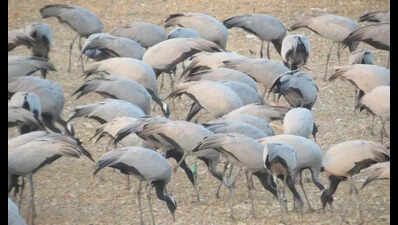
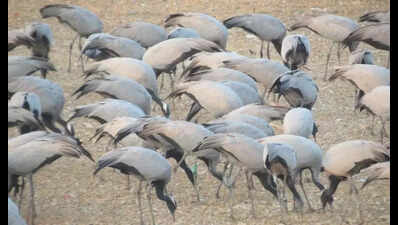
Jaipur: Four colour-ringed demoiselle cranes, each originating from a different region in Russia and Mongolia, have been photographed in Khichan, a Ramsar wetland site in Phalodi district, this season. One among them has flown a cumulative 47,060km over eight years, creating a notable record for the widely dispersed northern population of the species converging annually at this desert sanctuary.The four birds, documented by Chirag Mali, are from Khakassia and Tuva in Russia; Eastern Mongolia and Arkhangai of the country. The ring histories of the four show the transcontinental sweep of demoiselle crane migration and confirm Khichan’s unique position on the Eurasian flyway. “The four sightings show how deeply connected Khichan is to breeding grounds thousands of kilometres away,” said Mali, who was involved in the verification.Among the four, U3 ‘Shira’ is the most extensively tracked. Ringed on July 18, 2019, in Khakassia by Russian researchers, Shira was later documented in Tyva in 2024 before being photographed in Khichan on Dec 30, 2024, and again this winter. Now six years old, Shira arrived with its mate, two chicks, and a sibling named ‘Sholy’, indicating successful breeding in the northern range. “Shira’s repeated return to Khichan indicates strong site fidelity within the species. It shows that these birds navigate with remarkable accuracy,” said Dau Lal Bohra, a member of a crane specialist group at the International Union for Conservation of Nature (IUCN) and a contributor to the 1000 Crane Project.Yellow Ring 1917, banded as an unfledged chick on July 21, 2017 at Tsetserleg in Arkhangai, carries the longest documented history among this season’s recoveries. Now eight years old, it reflects the longevity of Mongolian crane populations and their dependence on wintering habitats in western Rajasthan.“In eight years it travelled a total of 47,060km to and fro. It’s a reassuring sign that long-distance migrants can survive many years of harsh ecological conditions when their flyways remain intact,” said Annegret Stubbe, a German researcher.The youngest bird, Green Ring Z28, offers insight into first-year navigation. Ringed on July 18, 2025, along the Khurkh river by the Wildlife Science Conservation Centre of Mongolia, it is completing its maiden journey. Its arrival underscores Khichan’s role as a safe wintering site for young cranes. “For a juvenile to reach India successfully is a major milestone. Every first-year recovery teaches us something new,” said Elena Ilyashenko, a member of the Crane Foundation in Central Asia.The fourth, Yellow–Blue Ring ‘Sukpak’, ringed in Tuva on July 20, 2024, confirms the participation of south Siberian populations in this shared wintering system. “Last year, it was ringed for the first time and it came to Khichan after covering 3,676km. So far, it has travelled approximately 11,000km. Tyva borders northwestern Mongolia and lies in the upper Yenisey River Basin. Due to the region’s harsh conditions, this was the first time researchers successfully ringed birds there. Since the ringing was done at a further location, it increased the migration distance,” said Bohra.