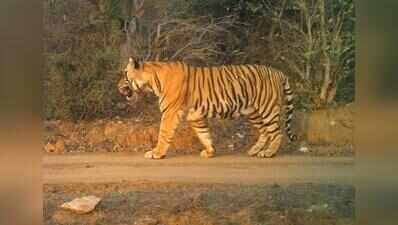
Jaipur: A fresh set of facial injuries has put the spotlight on Jai, one of Ranthambore’s well-known male tigers, with forest officials keeping a close watch on the nine-year-old. A territorial clash with another male is suspected, though this remains unconfirmed.“Our teams are monitoring Jai’s movements and health, making regular observations to detect any change in his condition. Further action will be decided on the basis of information gathered during surveillance,” said Manas Singh, DFO, Ranthambore National Park.Known as T-108, Jai is the offspring of tigress T-8, Ladli, and male tiger T-34, Kumbha. His territory stretches from the Phalodi range into Zone 6 and across Zones 7, 8, 9 and 10, with parts extending into Range of Project Tiger (ROPT) forest.“Territorial fights are part of a tiger’s struggle for survival. Such confrontations are not unusual when territories overlap,” said wildlife tracker and expert Abhishek Chaudhary.Chaudhary recalled that Jai was first sighted on Feb 9, 2017, and fought another male, Fateh, during the Covid lockdown. Jai was left bloodied in that encounter, after which Fateh disappeared from camera-trap footage, he said.Male tigers generally reach their prime between the ages of eight and 12, Chaudhary said, expressing confidence that Jai would recover.The incident has also drawn attention to pressure on tiger territories in Ranthambore. The reserve spans 1,334 square kilometres and has 10 core safari zones, where around 55 to 60 tigers are regularly sighted, according to the information provided.A study by Wildlife Institute of India (WII) estimated that Ranthambore’s core area and neighbouring Sawai Man Singh Sanctuary could comfortably sustain a maximum of 40 adult tigers. The population has since risen beyond 75, raising concerns about territorial overlap and competition for space.“Territorial overlap and competition for space have become a major concern,” said a wildlife expert, referring to the gap between the estimated carrying capacity and the reported tiger population.