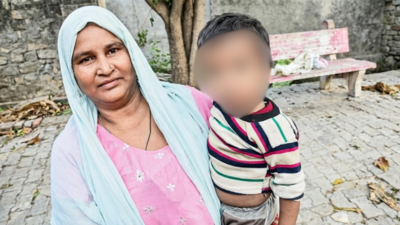
Kota: Five women who survived the surgical and caesarean procedures at Kota’s Govt Medical College Hospital and JK Lon Hospital in May and have since developed severe complications Wednesday sent a memorandum to President Droupadi Murmu, seeking immediate kidney transplants or permission for euthanasia.The women, whose trip to the hospital in May this year was filled with anticipation had turned, instead, into a 70-day — and counting — ordeal for the families in Kota. The women — Ragini Meena, Aarti Chopdar, Pinki Aerwal, Sushila Mahawar, and Dhanni Suman — are still trapped in a cycle of dialysis, illness and financial ruin.Inside the New Medical Hospital Super-Specialty Wing in Kota, they have been surviving on repeated assurances from doctors and govt officials, but shown no clear path to recovery. For families dependent on daily wages, private jobs and small vehicles for income, the crisis has now become both a medical emergency and an economic collapse.Pinki Aerwal, 25Pinki’s husband Naresh, a daily wage labourer from Kishorepura village near Sultanpur, about 40 km from Kota, says the medical crisis has completely halted his ability to earn.Pinki has undergone around 34 dialysis sessions — roughly two sessions every eight days. Instead of improving, Naresh said, every procedure has deepened her suffering.“I have been forced to put my livelihood on hold for the past two months to focus entirely on my family’s medical situation,” Naresh said, his voice heavy with exhaustion.He said Pinki’s condition worsened after the removal of the centre line used for treatment.“Due to the recent removal of the centre line, the patient has been continuously suffering from persistent vomiting, coughing and other complications. My only demand is that the authorities help us secure a kidney transplant,” he said.Naresh also said that while Lok Sabha Speaker Om Birla gave Rs 5 lakh each to families of the women who died, no financial help has been extended to surviving patients.For Pinki and Naresh, the hospital has become both a place of hope and helplessness. With no regular income and no assurance of a transplant, his family’s survival now depends on a public health system that, he says, has given them little beyond repeated promises.Arti Chopdar, 27Arti Kumari has been confined to a hospital bed since May 9. For more than two months, her days have been dictated by dialysis schedules and post-treatment complications.During a brief walk outside the hospital ward, Arti said she continues to suffer fever and cough after dialysis. “Depending on dialysis isn’t possible for the rest of our lives — we have our children to raise,” she said.Her family’s struggle is not limited to her treatment. Every dialysis session requires someone to bring her to hospital, stay with her and manage the household in the meantime. For working-class families, that means choosing between earning a livelihood and keeping a patient alive.“We are trapped in this cycle,” Arti said. “Our husbands either work for the livelihood or bring us here for the dialysis. We desperately plead to the govt for facilitating prompt action toward a kidney transplant as soon as possible, as the current situation is completely unsustainable for us.”Her appeal captures the central failure in the case: The women are alive because dialysis continues, but their families say the system has offered no durable solution and no financial cushion for the long wait.Ragini Meena, 29Ragini Meena, admitted on May 9, has spent the past 70 days battling serious health complications and the physical toll of dialysis every 48 hours.Like the other women, Ragini suffers fever and coughing after dialysis. But her anger is directed at what she sees as official inaction.“The whole administrative and medical staff is just carrying the trail of assurance and reassurance rather than any firm step toward our kidney transplantation,” Ragini said.Her brother Vikas, a resident of Itawa town in Kota district, said the family’s finances have collapsed. He said they have sold personal assets, including vehicles and jewellery, to manage expenses around care. He and Ragini’s husband Lokesh have also lost their private jobs while attending to her in hospital.Vikas said the family has now reached a point where it can no longer survive on assurances.“Doctors have now shrugged off, saying they have read the last chapter of their medical book for the treatment.Now you better take the patient at home,” Vikas said.The family is demanding urgent kidney transplantation, saying there is no way to sustain long-term dialysis without income, assets or state support.Dhanni Suman, 32Dhanni’s husband Mohan Lal, a taxi driver, said he was forced to sell his taxi — his only source of livelihood — to feed the family and sustain her treatment.Dhanni has undergone dialysis 32 times. Her baby, born on May 8 through C-section delivery, is being cared for by her sister-in-law, while her grandmother looks after Dhanni’s 5-year-old and 10-year-old children at home.For Mohan Lal, the medical crisis has split the family across hospital wards and homes, leaving children without their mother and a newborn dependent on relatives.He said Dhanni now panics at the mention of dialysis.“She is terrified of the word ‘dialysis’ now. Within an hour of starting the process, she begins shivering violently, vomiting and running a high fever,” Mohan said while recalling Dhanni’s trauma.The sale of his taxi has pushed the family into deeper uncertainty. Without the vehicle, Mohan has no stable way to earn. Without income, the family cannot sustain the hidden costs of hospitalisation. Without a transplant, Dhanni remains tied to dialysis.The family says it has submitted a memorandum to district authorities seeking a written commitment and timeline for kidney transplants. Mohan Lal said they will stop dialysis if no assurance is given, citing his inability to bear the emotional and financial burden any longer.Sushila Maharwar, 37The wife of daily wager Om Prakash, Sushila is also undergoing the agony of dialysis. A mother of three, she delivered her fourth child — a baby boy — who is under medical observation in NICU due to complications. Om Prakash told TOI he borrowed Rs 50,000 on interest to sustain the family since Sushila’s hospitalisation. He resumed work a few days ago to earn his wages, but said he was distressed because they have neither received any financial assistance nor any clarity on how long this treatment will continue.Nothing left to sellAcross the ward, the stories overlap: women weakened after childbirth, families camping in hospital corridors, children growing up without their mothers, jobs lost, vehicles sold, jewellery pawned or gone.Govt hospitals may be covering core medical charges, but poor families say that is not enough when treatment stretches for months and the breadwinners are forced to stop working.Their demand is now singular: immediate govt action to facilitate kidney transplants.When contacted, NMCH principal Dr Nilesh Jain told TOI the women are stable and undergoing dialysis as needed to support kidney function until recovery.Addressing the survivors’ refusal to accept dialysis, Jain said this is a life-saving procedure and that the district administration will be asked to intervene if the families continue to decline it. Jain also said patients suffering from acute renal failure must be monitored for three to six months before being classified as having end-stage renal disease. “Any transplant discussion is premature, though the nephrology head will make the final assessment,” Jain said.