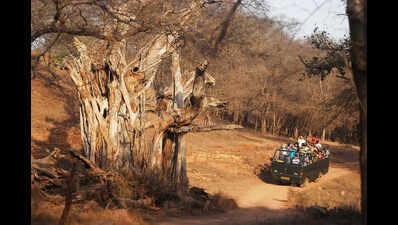
(Photo- Bhagirath Basnet)
In the mid-2000s, Rajasthan’s tiger presence was largely restricted to Ranthambore National Park. The state had around 18 tigers in 2006 and fewer than 30 in 2008. Today, Rajasthan holds nearly 140 tigers, with their presence spreading far beyond a single reserve.From only two tiger reserves spread across limited forest patches, Rajasthan today has six tiger reserves across 6,000 sq km stretching across Sawai Madhopur, Karauli, Bundi, Kota, Dholpur and Alwar.The turning point came after Sariska lost all its tigers to poaching in 2005, triggering one of India’s most significant wildlife recovery experiments. In 2008, tigers were relocated from Ranthambore to Sariska under a pioneering reintroduction programme that later became a national model for carnivore relocation. The early years were filled with uncertainty. Some tigresses failed to breed, dispersing males moved outside the reserve and human disturbance inside core areas continued to pose challenges.Yet, the effort slowly stabilised. Today, Sariska has over 50 tigers and is widely regarded as one of the country’s most important conservation recoveries. “Initially, there were many hiccups and a few persist. Many tigresses did not give birth, but conservation efforts have yielded results,” said Dinesh Durani of Sariska Tiger Foundation.Securing NumbersFormer forest officials say Rajasthan’s challenge has now shifted from increasing tiger numbers to securing space for dispersing animals. Forest corridors connecting Rajasthan and Madhya Pradesh are being reassessed, while Ramgarh Vishdhari Tiger Reserve has emerged as a crucial link between Ranthambore and Mukundra Hills Tiger Reserve. The Dholpur Tiger Reserve is securing another important stretch of the Chambal landscape.Mukundra Hills Tiger Reserve reflects the difficulties that often accompany ambitious wildlife projects. Conceived as another major tiger habitat, the reserve struggled to stabilise its population despite repeated efforts, underlining the complexity of large carnivore conservation. Officials said reintroduction plans are not always successful. The first population in 2018 died under mysterious circumstances and current efforts for population revival have yielded nearly seven tigers.Challenges persistFormer chief wildlife wardens and senior forest officials involved in the process say the rapid increase in tiger numbers has brought a new challenge — finding space for dispersing animals. According to forest officials, tiger occupancy in Ranthambore and nearby areas has expanded from around 400 sq km in 2005 to nearly 1,700-2,000 sq km now, though this still covers only about 30% of the identified tiger landscape.Tourism turns wildlife into an economic forceRajasthan’s conservation model evolved differently from many other states because wildlife gradually became linked with local livelihoods. Around reserves and safari zones, forests started generating employment and economic activity for nearby communities.Ranthambore became the shining example of this transformation. Safari tourism expanded rapidly over the years, creating work for guides, drivers, resort staff, naturalists and villagers living around the reserve. Forest officials say Ranthambore alone recorded more than 6.6 lakh tourist visits in the last financial year, generating nearly Rs 71 crore in revenue.Rajasthan’s leopard landscapes draw global attentionAlongside tigers, Rajasthan also emerged as one of India’s leading leopard safari destinations.Jhalana Leopard Reserve became a landmark project after it formally opened for safaris in 2018 under the country’s first dedicated Project Leopard initiative. Located within Jaipur city, the reserve soon gained national attention for its unusually high leopard sightings inside an urban landscape.At the same time, Jawai Bandh developed a very different conservation story. Here, leopard conservation evolved not through official programmes, but through long-standing coexistence between local communities and wildlife. Leopards moved freely among temples, caves and grazing areas, while villagers largely tolerated their presence across the rocky landscape surrounding Jawai Bandh.Over time, Jawai became internationally known for this coexistence model. Celebrity visits, documentaries and social media exposure further boosted the region’s popularity.Success also brought pressure. Conservationists have increasingly raised concerns over unregulated construction, tourism expansion and growing disturbance around leopard habitats. “The Rajasthan High Court recently stayed new tourism activities and construction in Jawai amid concerns over unchecked development,” said an advocate.Great Indian Bustard conservation finds new hopeWhile tiger and leopard conservation brought visibility and tourism, Rajasthan simultaneously became the centre of one of India’s most critical species recovery programmes involving the Great Indian Bustard.Once commonly found across the Thar Desert, the bird suffered a sharp decline due to habitat loss, power lines, changing land use and disturbance across grasslands. With fewer than 200 believed to survive in the wild, Rajasthan emerged as the heart of national conservation efforts.Rajasthan strengthened protection measures around 2011 before Project GIB formally took shape in 2016 and Jaisalmer’s desert landscape became the centre of the recovery mission. Scientific conservation methods introduced at breeding centres in Sudasari and Ramdevra brought new momentum to the programme. Artificial incubation, controlled breeding and close monitoring helped stabilise the species inside conservation facilities.“The recent birth of new chicks pushed the total captive population to more than 80 birds, offering cautious hope for a species once considered nearly impossible to recover. The next phase will focus on rewilding and preparing birds for eventual release into protected habitats,” said Rishi Singh Rathore, a wildlife enthusiast.Rajasthan’s importance for bird conservation has also expanded internationally. Jorbeer Conservation Reserve and Desert National Park were recently included in the Global Action Plan for Conservation of the Steppe Eagle under the UN-backed Convention on Migratory Species.Sambhar tragedy exposed fragile ecosystemsRajasthan’s conservation journey also witnessed one of the country’s worst ecological disasters. In 2019, more than 18,000 migratory and resident birds died due to avian botulism in and around Sambhar Lake. It was the first time such a massive bird mortality linked to the toxin had been recorded in India.Investigations by the Indian Veterinary Research Institute later found that fluctuating water levels, rising salinity after the monsoon, warm temperatures and decaying aquatic organisms created ideal conditions for the bacteria Clostridium botulinum to spread.The tragedy exposed the vulnerability of Rajasthan’s wetland ecosystems and raised concerns over climate-linked ecological changes, while pushed authorities towards stronger monitoring and surveillance systems, said Bajrang Prajapat, a local resident.Conservationist Dau Lal said Sambhar gradually witnessed the return of migratory birds over the following years, though concerns over the wetland’s long -term ecological health continue to remain.