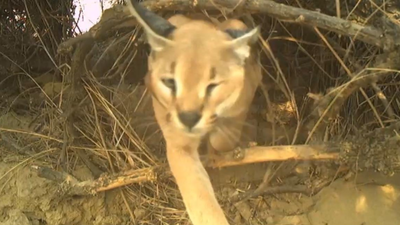
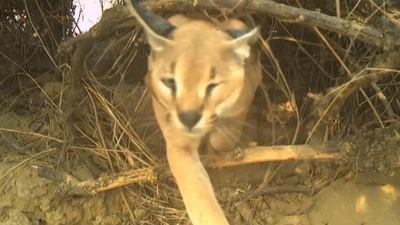
After the reintroduction of cheetahs in India, another rare and highly mysterious wild cat — the Caracal — is now drawing attention as it stands on the brink of extinction in the country. In a significant conservation breakthrough, a caracal was successfully fitted with a radio collar for the first time in the deserts of Jaisalmer on January 25. Since its release into the wild, forest officials have been continuously monitoring its movements through the collar’s satellite tracking system.In recent days, the collared caracal’s activity has been recorded near the India–Pakistan international border. The animal was tracked to a hunting site, where the presence of another caracal was also confirmed nearby. Officials believe that possible interaction between the two may have led the first caracal to move closer to the international boundary. At present, its movement appears to be restricted to an area of about 5–6 square kilometers.Given its proximity to the border, the Forest Department is coordinating closely with the Border Security Force (BSF) to ensure proper monitoring and protection of the animal in sensitive border areas.Chief Conservator of Forests (CCF), Jodhpur, Anoop K.R., stated that western Rajasthan could potentially host the largest remaining wild population of caracals in India. Since the male caracal was released back into its natural habitat on January 25, satellite tracking and ground-level monitoring have been carried out continuously.Local villagers have also reported sightings of multiple caracals in the region, strengthening the belief that the Thar desert landscape may be an important refuge for this elusive species.Importantly, the Rajasthan government has initiated a special conservation project for the caracal in collaboration with the Wildlife Institute of India (WII). Under this initiative, mapping of distribution areas and habitat characteristics is being undertaken in Karauli and Sawai Madhopur districts with active participation from local communities. Efforts are also being made to refine wildlife management practices and develop scientific population assessment methods for the species.Preliminary findings suggest that western Rajasthan may indeed represent the most significant remaining habitat for caracals in India, making the region critically important for the species’ long-term survival.Under the guidance of CCF Anoop K.R., a joint team from the Forest Department and WII successfully rescued the male caracal on January 25, fitted it with a radio collar, and released it safely back into the wild. The operation was conducted with scientific precision and utmost care, ensuring the animal’s safety and health throughout the process.The caracal is considered a rare and extremely elusive wild species. Sightings are uncommon, and scientific data on its behavior and ecology remain limited. Through radio collaring, researchers are now gathering vital information on its movement patterns, habitat use, behavior, and hunting range. This data is expected to significantly strengthen conservation strategies.Scientists believe that the desert ecosystem of Jaisalmer provides a crucial natural habitat for the species. After many years, systematic monitoring of this endangered wild cat has resumed — a major and commendable step toward securing its future in India.