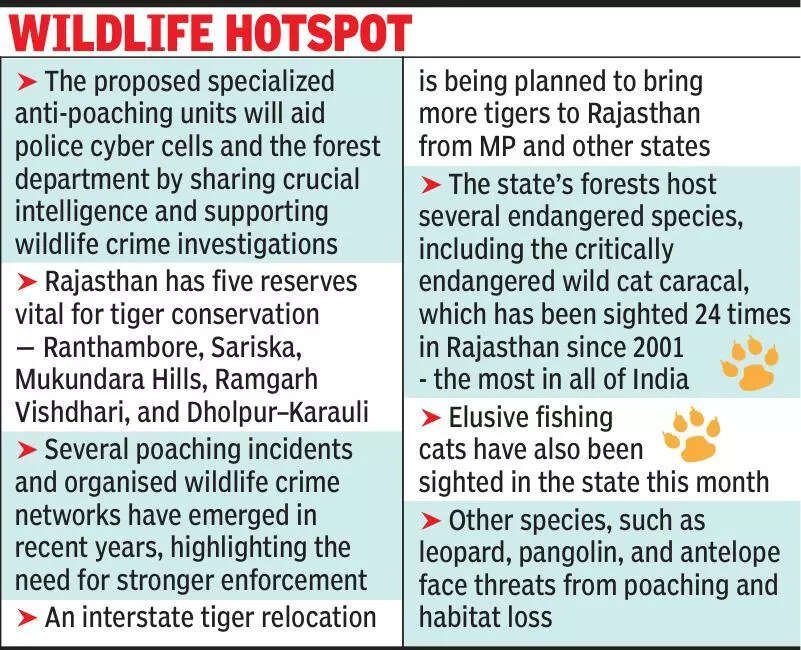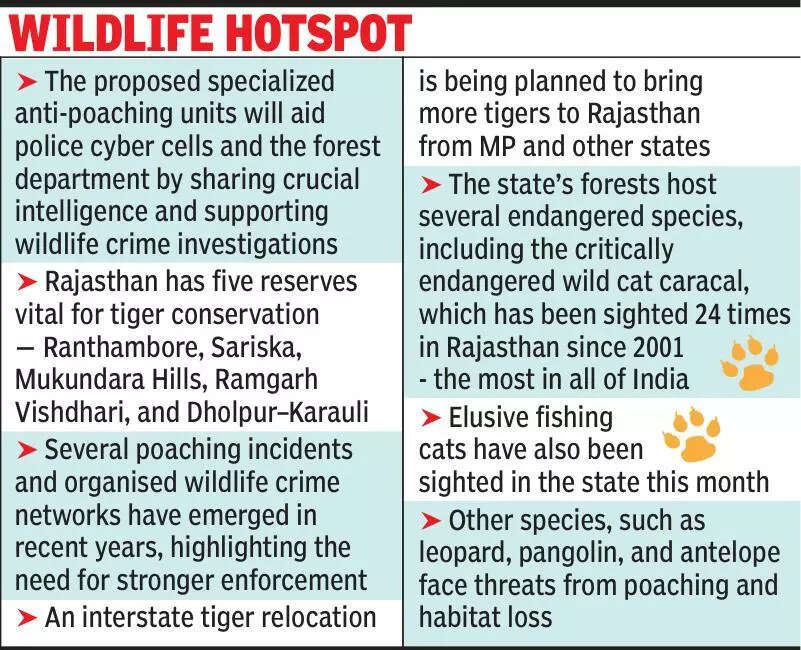
Jaipur: The state govt has approved the establishment of new anti-poaching units to strengthen wildlife protection across tiger reserves and state sanctuaries.A sum of Rs 27.6 crore has been earmarked to pay for 35 new anti-poaching units that will come up in Ranthambore, Sariska, Ramgarh, and other sanctuaries.“These outposts will be equipped with modern communication devices, vehicles, and advanced surveillance systems for enhanced night patrolling capabilities and remote monitoring,” a forest official said.The new units will become operational by 2026–27.With the state’s tiger population in the wild crossing 125, and many endangered species like caracal and fishing cat being spotted in different protected areas, the new units will play a key role in protecting wildlife.“The current high-tech surveillance systems installed to track big cats and curb poaching in Ranthambore Tiger Reserve (RTR) and Sariska Tiger Reserve (STR) have virtually collapsed,” a senior forest official said.TOI had earlier reported that only one of 12 wildlife surveillance cameras is still functional in Ranthambore.“A majority of similar cameras in Sariska are also defunct,” the senior official informed.“These were installed under the Wildlife Surveillance and Anti-Poaching System (WSAPS) and intended to strengthen protection. However, they have proved to be of very little use,” he added.As Rajasthan shares extensive land borders with several other states, it has become a potential corridor for wildlife trafficking, especially of tiger parts, pangolin scales, and turtles.“In the past, we have seen evidence of the involvement of organised criminal networks targeting Rajasthan’s tigers, leopards, pangolins, antelopes, and other wildlife species,” a wildlife expert told TOI.“Such wildlife crimes can be effectively controlled and prevented through intelligence-based patrolling and proactive action,” he added.
State to get new anti poaching units, 27.6 crore sanctioned | Jaipur News