JAIPUR: Rajasthan led India’s solar power expansion, contributing nearly 27% of total installed capacity by the end of FY2025–26, as national solar capacity reached 150,260MW.Gujarat ranked second with about a 20% share. Combined, Rajasthan and Gujarat accounted for nearly 47% of India’s solar capacity, underscoring their outsized role in the country’s clean energy transition.However, the state is facing acute challenge of transmitting power due to lack of transmission capacity.
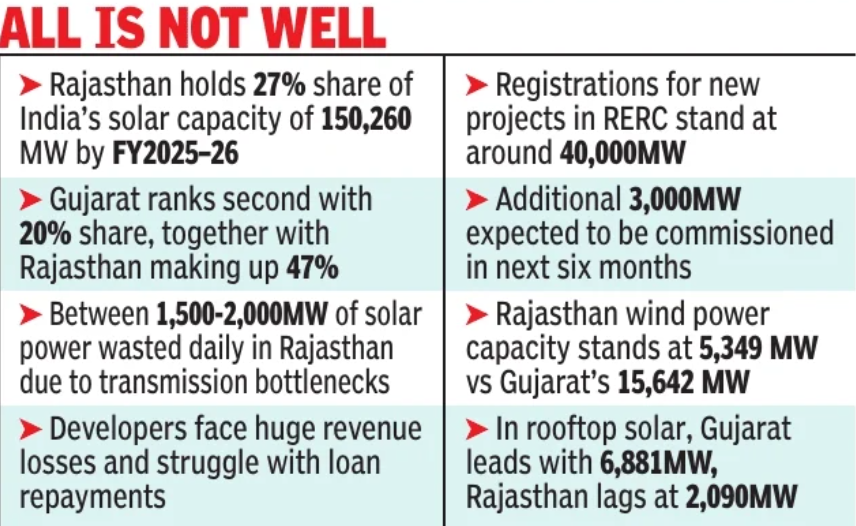
“Solar power operators in Rajasthan are worried. They are unable to use between 1,500-2,000MW power daily due to lack of transmission infrastructure. It is not only a national loss but puts the state in poor light,” said DD Agarwal of Samta Power, a sectoral NGO.They have won these projects on competitive bidding and financed them through loans. “Since they cannot take the power they produce, they are suffering huge losses affecting their revenue generation and meeting financial obligations to banks and financial institutions,” added Agarwal.Meanwhile, registrations for new solar projects at Rajasthan Renewable Energy Corporation have increased to about 40,000 MW, including both utility scale and decentralized plants.A source in the corporation said that another 3000MW of solar projects are expected to be commissioned in the next six months. “If the state does not create new transmission capacity and battery storage systems with urgency, many of the capacity will get wasted, affecting investor interest in the state,” the official said.While Rajasthan remains a leader in the state by a huge margin, Gujarat has been the top performer having maximum renewable energy projects.It has outpaced Rajasthan in wind power capacity by a huge margin. By the end of 2025-26, Rajasthan had a cumulative wind power capacity of 5,349MW against Gujarat’s 15642MW.Similarly, Gujarat is miles ahead in the rooftop solar segment as well, having the highest capacity of 6,881MW. Despite being a leader in solar, Rajasthan has failed to ramp up its rooftop solar power installation, which is languishing at 2,090MW, according to Ministry of New and Renewable Energy data.