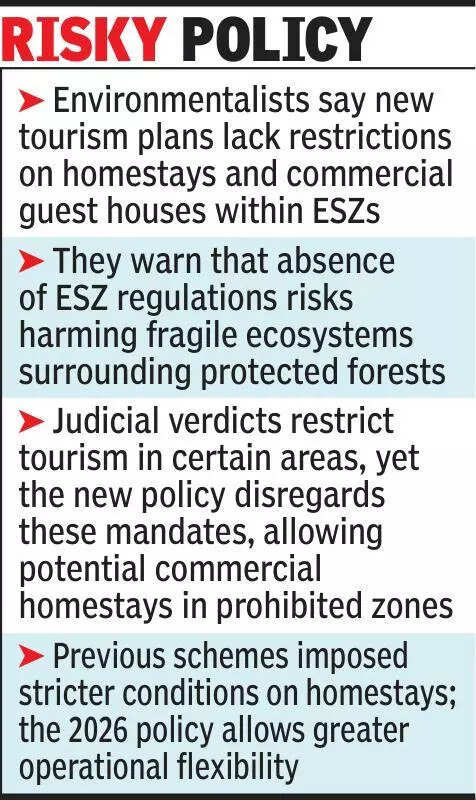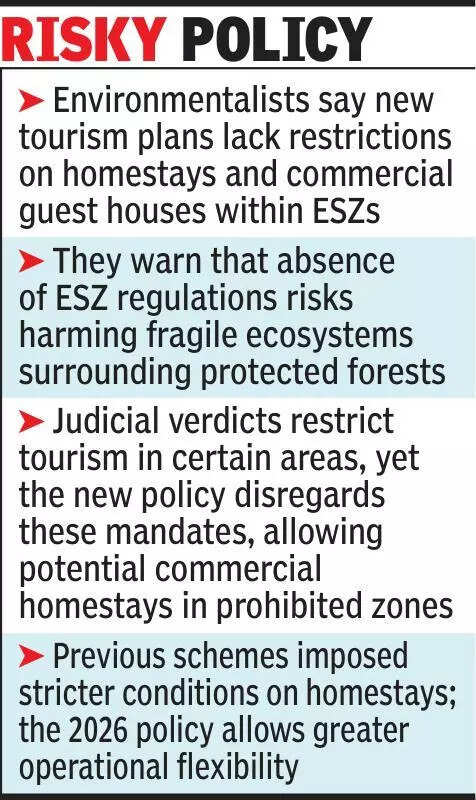
Jaipur: The Rajasthan state tourism department’s new Homestay Paying Guest House Scheme 2026 has sparked alarm among environmentalists and conservationists due to alleged lack of safeguards for eco-sensitive zones (ESZs) near wildlife sanctuaries. Under current ESZ policy norms, agricultural land owned by locals may be converted for homestay purposes only if recommended by the monitoring committee of the ESZ and with prior approval from the competent authority under the Regional Town Planning Act. Environmental lawyer Rituraj Singh alleged, “In the schemes introduced by the Rajasthan tourism department, no restriction has been imposed regarding commercial guest houses or homestays within ESZ or the one-km prohibited area. This will allow homestays to mushroom within ESZs.” Experts point out that ESZs are areas officially designated by the Union Ministry of Environment, Forest and Climate Change surrounding protected forests and wildlife sanctuaries. Typically, these zones extend up to 1-km from a sanctuary boundary, aimed at regulating development and safeguarding fragile ecosystems. Tapeshwar Singh, another environmental lawyer, said, “If this homestay scheme is allowed, forest norms will be diluted.” Judicial verdicts have consistently reinforced these restrictions. The Supreme Court, in the landmark case of TN Godavarman Thirumulpad versus Union of India and Others, mandated that any area lacking a draft or final ESZ notification should be treated as a completely prohibited zone within a 1-km radius of protected forests and wildlife sanctuaries. Similarly, the Rajasthan High Court ruling in Rituraj Singh versus State Govt regarding Kumbhalgarh upheld that commercial hotels and tourism activities remain banned within the 1-km buffer zone. Despite these established rulings, the 2026 scheme remarkably omits any mention of restrictions on commercial guest houses or homestays within ESZs or the 1-km prohibited area, potentially paving the way for commercial homestays akin to small hotels near sensitive environments. A senior tourism official acknowledged the absence of ESZ restrictions in the scheme but did not elaborate further. Earlier policies provided clearer guidance, such as the Rajasthan Paying Guest House Scheme 2012, which limited commercial use to five rooms and mandated owner residence on the premises. The 2026 scheme allows for up to eight rooms with a total of 24 beds, significantly relaxing earlier requirements by permitting operations via a caretaker or manager. The Rajasthan Rural Tourism Scheme 2022 included explicit ESZ provisions, underscoring the need for clarity in the new homestay policy to balance tourism growth with environmental conservation.
Raj homestay scheme does away with ESZ safeguards | Jaipur News