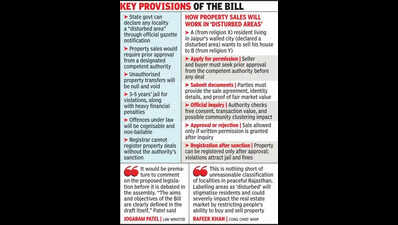
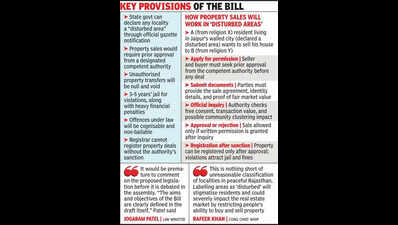
Jaipur: Rajasthan govt is set to introduce the “Rajasthan Prohibition of Transfer of Immovable Property and Provision for Protection of Tenants from Eviction from Premises in Disturbed Areas Bill, 2026” in the assembly this Friday.The proposed bill aims to enable the state govt to designate any locality as a “disturbed area,” allowing for stringent regulation on property transactions there, much like existing legislation in Gujarat, enacted in 1991. Under the draft law, localities deemed at risk of riots, mob violence, or serious threats to public order can be classified as disturbed areas through an official gazette notification. “The govt may declare any area a disturbed area having regard to the intensity and duration of riots, mob violence or other factors affecting public order,” the bill says. One centerpiece provision of the proposed legislation is the requirement for prior permission from a designated authority for any sale or transfer of property within these disturbed areas, making unregulated property transactions nearly impossible. Areas such as Jaipur’s walled city, characterised by their mixed populations and frequent property dealings, could be heavily impacted by the new regulations. The process for designating an area as disturbed will hinge on analysing the severity and duration of past disturbances and any demographic tensions that may threaten local peace. A notified area, once established, can remain classified as such for up to three years, with provisions for both extension and withdrawal based on improvements in local conditions. Should individuals wish to sell property within a disturbed area, they must apply to the competent authority, which will investigate factors including the consent of both parties, fair market pricing, and the potential for demographic imbalance due to property sales. “The competent authority shall examine whether the proposed transfer may result in improper clustering of persons of one community affecting demographic equilibrium,” the bill specifies. Additionally, the legislation outlines severe penalties for violations. Offences under this law will be cognisable and non-bailable, carrying prison sentences of three to five years and fines reaching a minimum of Rs 1 lakh or 10% of the property’s value, whichever is higher. While some BJP members argue such a law is essential to prevent the migration of Hindu residents from mixed neighbourhoods, legal experts caution that the bill may face significant judicial challenges. Advocate-on-Record Ajay Singh warns that provisions regulating transactions based on “clustering” could infringe upon constitutional rights. “Such provisions may raise questions about fundamental rights, including equality and the freedom to reside and settle anywhere in India under Article 19,” he says.