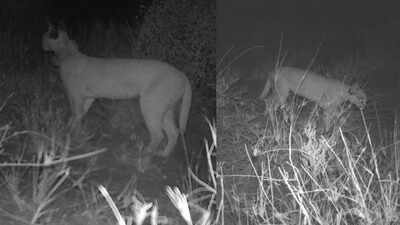
JAISALMER: In the border area of Ghotaru in Jaisalmer, considering the possible presence of the endangered and near-extinct Schedule I wild animal, the caracal, the Forest Department has started using motion-sensing camera traps at select locations to track its movement and activity.At present, only a limited number of camera traps have been installed. These cameras have confirmed the movement of two new caracals. In addition, the activity of a radio-collared caracal in the same region is being closely monitored to record and understand its behavioral patterns. Under the guidance of Jodhpur CCF Anoop K.R., a team led by IGNP-II DFO Devendra Singh Bhati in Jaisalmer is actively monitoring caracal movement through these sensing camera traps.Alongside this, a team from the Wildlife Institute of India (WII) is also conducting studies on the movement and behavior of caracals in the Thar Desert. So far, camera traps have recorded the movement of three caracals.CCF Anoop K.R. stated that, given the indications of caracal presence in the Ghotaru region of the Thar Desert, additional motion-sensing camera traps have been installed, which captured two new individuals. Including the previously radio-collared caracal, the confirmed count now stands at three. He also mentioned that one caracal was earlier hunted and burned in an attempt to destroy evidence in the Bachhiya area of Jaisalmer.He further emphasized that a large number of cameras will be required to survey the entire habitat of the caracal, especially across the Thar Desert. A comprehensive plan for this will be prepared and implemented after the completion of the current study.Locally known as “Padang,” the rare and endangered caracal occasionally preys on sheep and goats, leading villagers to perceive it as a threat and sometimes attempt to kill it. In response, the Forest Department team of IGNP-II division, led by Devendra Bhati and Ranjit Singh Dholiya, is conducting awareness campaigns in remote border hamlets to educate local communities and reduce conflict. They are also continuously monitoring camera trap activity.CCF Anoop added that villagers are being advised not to harm the animal even if it attacks livestock. Instead, they are encouraged to report such incidents to the Forest Department. The department has assured shepherds that any “problem-causing” animal will be safely captured and relocated.Senior forest officials and wildlife experts are working together to develop appropriate strategies for handling captured animals and ensuring their conservation. The initiative aims to minimize human-wildlife conflict and secure the survival of this rare and endangered species.Dr. Sumit Dookia, Associate Professor at Guru Gobind Singh Indraprastha University and Honorary Scientific Advisor to ERDS Foundation, noted that the caracal population in Jaisalmer represents one of the last remaining populations of this rare wild cat in India. Since last year, regular reports of tracks and signs have been coming from the Ramgarh-Shahgarh landscape.He explained that this region is a typical arid grassland habitat where the Indian gazelle is the primary wild herbivore. While human settlements are sparse, the area is frequently used by nomadic pastoralists throughout the year.He described the recent incident of a dead adult caracal as highly alarming, indicating a growing conflict between local shepherds and this rare species.