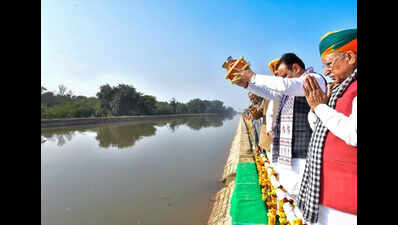
Jaipur: Chief minister Bhajan Lal Sharma Friday laid the foundation stone for the Rs 670-crore upgrade of the Ferozpur feeder of the Gang Canal in Sriganganagar.This marks 100 years since the original foundation stone was laid by Bikaner’s ruler, Maharaja Ganga Singh, on Dec 5, 1925. The project seeks to modernise one of north India’s most significant irrigation lifelines and expand its capacity for the next generation of farmers. Other than the sum allocated for the upgrade of the feeder, the Rs 300 crore restoration of the Bikaner Canal will directly benefit lakhs of farmers. In the first phase, Rs 695 crore will be invested to automate irrigation across 3.14 lakh hectares, ensuring greater efficiency and improved farm productivity. “A total of Rs 1,717 crore will be spent on the canal system in the region,” said CM Sharma. The project is targeted to be completed on schedule, coinciding with the inauguration day of the historic Gang Canal in October 2027,” CM Sharma said at the ceremony. The newly launched reconstruction project—undertaken jointly with Punjab—is expected to provide a major boost to irrigation in north Rajasthan. Once completed, it will deliver an additional 4,000 cusecs of water to farmers in Sriganganagar and Hanumangarh. The project focuses on upgrading the Firozpur Feeder—the crucial channel that supplies water to large agricultural belts of the region. Once reconstructed, its carrying capacity will rise from 9,000 to 13,842 cusecs, allowing Rajasthan to store surplus monsoon water that currently drains toward Pakistan, while significantly improving irrigation across nearly 3.14 lakh hectares of farmland. Conceived in 1899-1900, the idea of the canal took 25 years to materialise, culminating in a landmark tripartite agreement between the princely states of Bikaner, Bahawalpur (now in Pakistan), and Punjab. The canal became functional in 1927. At the time, the agreement sparked protests in Punjab, where leaders accused Maharaja Ganga Singh of lobbying the British govt to secure what they saw as a disproportionately large share of Sutlej water—water they argued was meant primarily for the people of undivided Punjab. Highlighting the historical context, Nitin Goyal, Research Fellow at the Oriental Research Institute, Bikaner, said: “Between 1905 and 1925, Maharaja Ganga Singh made repeated representations before the British govt, arguing that without irrigation, the people of Bikaner faced inevitable ruin. His persistence culminated in the tripartite agreement, despite strong resistance—especially in Punjab, where leaders claimed he lobbied for an ‘unfair share’ of water.” The canal’s construction faced formidable challenges. Bahawalpur and Punjab state strongly opposed allowing Bikaner to draw water from the Sutlej. Technical experts doubted the feasibility of transporting water across such long distances to arid Bikaner. Bureaucratic hurdles and territorial disputes repeatedly stalled the project. World War I (1914–1918) further slowed negotiations and construction work. Despite these hurdles, Maharaja Ganga Singh persisted, driven by the catastrophic 1899 famine and his pledge to save his state from recurring drought. A century later, Rajasthan’s reconstruction of the canal seeks to honour that legacy—while preparing the region’s agricultural backbone for future challenges.