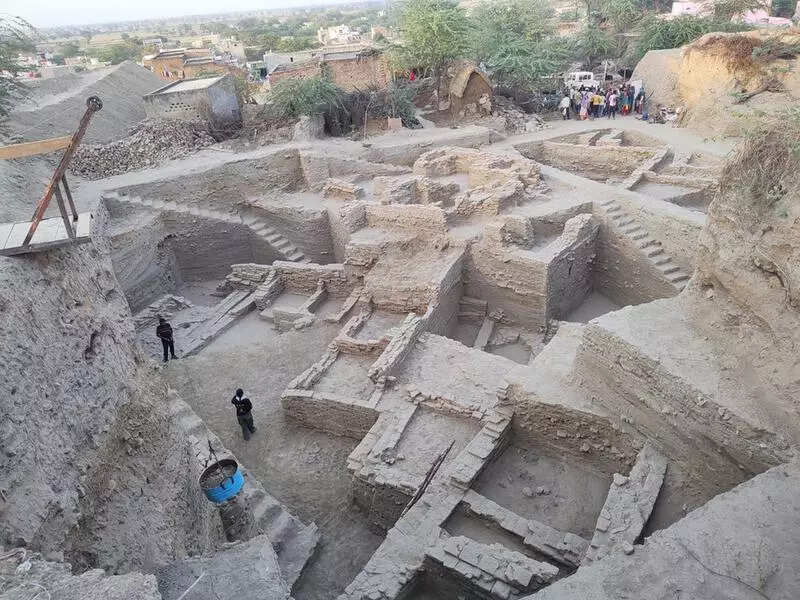
Jaipur: Rajasthan’s most significant archaeological excavation in terms of depth — palaeolithic stone tools, furnaces, terracotta figurines, mud bricks, and relics from the Copper and Iron Ages — is at risk of irreversible damage from monsoon rains, with no formal protection in place. The site, in Deeg district’s Bahaj village has trenches running 23 metres deep. The uncovered residential structures, copper and iron artefacts, and microlithic tools dating back 5,000 years are now caught in bureaucratic limbo between the state’s department of Archaeology and Museums (DAM) and Union govt’s Archaeological Survey of India (ASI). The excavation, carried out last year by ASI’s Jaipur Circle, remains unprotected under either bodies, leaving the ancient settlement vulnerable to damage.“The most common method of safeguarding an excavation site is to refill it with sand to prevent erosion or collapse due to rains. Ideally, this should be done immediately after fieldwork concludes,” said Neeraj Tripathi, superintendent of DAM’s Jaipur Circle. He said obtaining ‘protected’ status for such a site under existing legislation takes several months, and delays can prove costly. Over 4,500 artefacts were unearthed during the excavation. While movable artefacts were secured by ASI, deeper trenches, which offer vital insight into settlement patterns, architecture, and cultural evolution have been left exposed to the elements.Zafarullah Khan, a former DAM official, criticised the absence of preventive measures. “The agency conducting the excavation is responsible for its protection and for refilling the site. How can ASI wait for another authority to step in? That’s basic excavation protocol.”An ASI official in Delhi, however, pointed to Rajasthan’s Heritage Conservation and Promotion Authority (HCPA) as the responsible body. “We requested RHCPA to arrange protective infrastructure like a canopy and water drainage outlets. ASI can only undertake such measures if the site is under our protection,” the official said.Currently, the only safeguard in place is a rope boundary around the site to restrict local movement. With Bahaj village housing a population of over 10,000, experts fear the site is at high risk of being damaged by monsoon runoff, livestock intrusion, or unintentional human activity.Expressing concern over the situation, Deeg district magistrate Utsav Kaushal told TOI, “Since the site is under ASI’s operation, we have conveyed to them our full support. Any kind of logistical assistance required to protect the site from monsoon damage will be provided promptly.”
Bureaucratic limbo, monsoons threaten Deeg archaeological site | Jaipur News