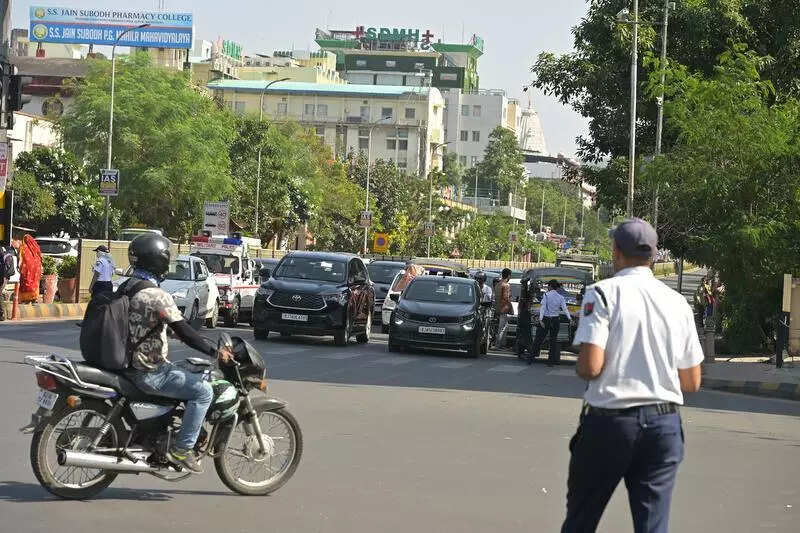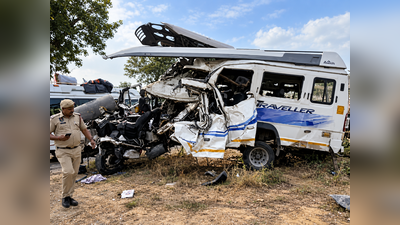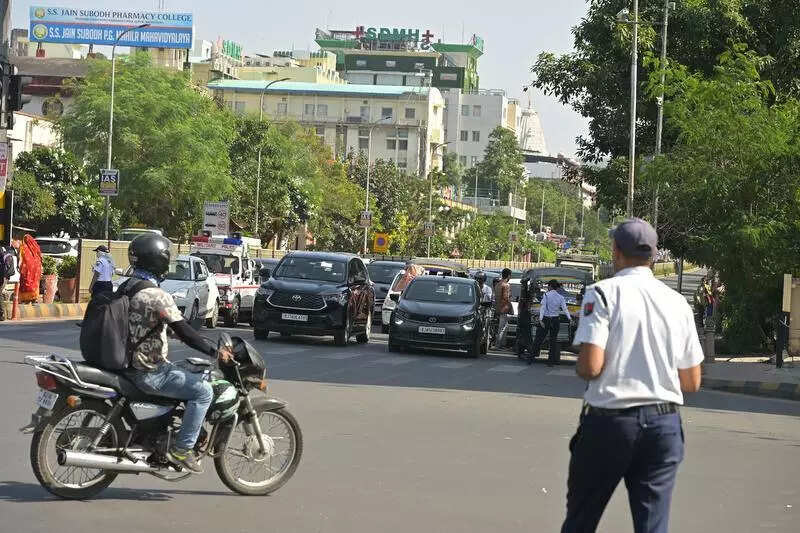
Jaipur: For a city that ranks third in the country for road accident deaths, Jaipur’s thin blue line, its overworked and short-staffed traffic police, stands alarmingly fragile.According to the latest National Crime Records Bureau (NCRB) 2023 data, Jaipur reported 848 road accident deaths, trailing only New Delhi (1,457) and Bengaluru (915).The tragedy of Jaipur’s roads resurfaced sharply after 13 people were killed when a dumper ploughed into several vehicles in Harmada on Monday. While the state govt has promised road safety campaigns to address the gaps, officials and experts say the problem runs far deeper than awareness drives. Jaipur’s road safety crisis stems from a chronic shortage of personnel, outdated enforcement systems, and infrastructure that has long outlived its design capacity.According to one official, the city has a sanctioned strength of 1,500 traffic personnel, of whom only 1,200 are deployed in the field on any given day. These 1,200 field officers are responsible for regulating more than 30 lakh registered vehicles, including nearly 3 lakh commercial ones, in a city whose population now exceeds 40 lakh. An officer said the ratio works out to roughly one traffic cop for every 3,000 residents. Officials estimate that the city needs at least 7,200 personnel to effectively manage its intersections, corridors, and highways.This thin blue line, already stretched beyond its limits, must still carry out enforcement duties at intersections, handle accident response, check for drunk driving, manage diversions, manage VIP movements, and investigate crashes. A senior officer admitted, “We are managing a metro city’s chaos with the manpower of a small district. Most cops are working double shifts in heat, dust, and fumes.”Against this backdrop of shortage stands the city’s swelling vehicle count and density. The Rajasthan State Pollution Control Board (RSPCB), in collaboration with the Central Road Research Institute, found that the Chandpole area alone recorded a daily traffic volume of 3.3 lakh vehicles, the highest in the city as per its 2024 study. RSPCB’s report pegged Jaipur’s vehicle density at a staggering 25,048 vehicles per square km, far higher than the state average of 4,299 vehicles per sq km. “Against the backdrop of this challenge, we function with barely one-sixth of the required strength,” an official said.The city’s traffic load is no longer supported by its existing road network. The city’s arterial roads, including Tonk Road, Ajmer Road, and Sikar Road, were designed when the traffic density was below 200 vehicles per kilometre. That figure has now crossed 1,000 vehicles per kilometre on several stretches. According to the TomTom Traffic Index published earlier this year, an average 10 km drive in Jaipur takes 28 minutes and 28 seconds, ranking the city ninth slowest in India and 52nd globally in time taken to cover the same distance.In such conditions, when accidents occur, the system strains to respond. “If an accident or mishap takes place, traffic police have to stretch every resource to move personnel from one junction to another. We are maintaining accident registers, but traffic police stations don’t even have the power to register FIRs,” said an officer.Adding to the pressure is Jaipur’s outdated enforcement infrastructure. While other cities like Hyderabad and Pune use AI-powered tools for real-time surveillance and traffic management, Jaipur still relies almost entirely on manual operations. Only a few Automatic Number Plate Recognition (ANPR) cameras are functional, and radar-based speed monitoring is used sporadically. The city traffic police has just 110 breathalysers for all its anti-drunk-driving operations. While all police stations have their own breathalysers, it is still far short of what is needed for sustained enforcement. As the recent dumper tragedy exposed, such drives are mostly limited to festive periods and not part of a continuous campaign.Officials said that despite the limitations, the force attempts to deploy its manpower in a “stratified and dynamic” manner. Areas with higher traffic concentration, such as Walled City corridors and main city areas, receive more personnel, but that leaves smaller roads and outer routes largely unmonitored. One senior official said, “We try to move teams depending on daily congestion patterns, but with such limited numbers, we can only react, not manage.“Even basic challenges like responding to breakdowns or accidents often leave intersections unmanned for long stretches. The imbalance between traffic growth and policing capacity has created a vicious cycle — worsening congestion, rising tempers, and dangerous violations becoming routine.
Cop Out: City Traffic Force Stretched, Snapped | Jaipur News