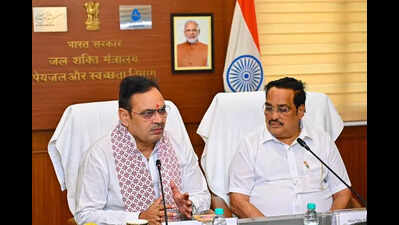
Jaipur: Rajasthan signed a Memorandum of Understanding (MoU) with the Union Ministry of Jal Shakti Tuesday under the revised guidelines of Jal Jeevan Mission (JJM) 2.0, securing an extension of the scheme until Dec 2028 and positioning the state to achieve 100% household tap water coverage.The MoU was signed in New Delhi in the presence of Union Jal Shakti minister C R Paatil, Chief Minister Bhajan Lal Sharma and Rajasthan Public Health Engineering Department minister Kanhaiya Lal Choudhary.Rajasthan, which currently has around 58% tap water coverage, ranks fourth from the bottom – ahead only of Kerala, Jharkhand and West Bengal – on the dashboard of top performers in the first phase of JJM, which concluded in 2024. The extension under JJM 2.0 is expected to provide a critical push to bridge existing gaps and ensure universal tap water access, with the agreement covering 11 key structural reform areas aimed at strengthening governance, institutional capacity and the long-term sustainability of rural drinking water systems.CM Sharma said the state, keeping public interest in mind, had urged the Centre to allow implementation of JJM 2.0 under revised guidelines. The MoU was finalised following the Centre’s approval.He termed the MoU a major step towards strengthening the state’s water supply infrastructure and ensuring clean drinking water for every household.“The state govt is committed to providing safe drinking water to every home, and this MoU will help accelerate the mission with better Centre-state coordination,” he said.Officials indicated the revised guidelines under JJM 2.0 will help Rajasthan fast-track pending connections and improve service delivery, particularly in rural and water-scarce regions like Jaisalmer, Barmer, Pali, Sirohi, Jodhpur, Churu, Sikar and Jhunjhunu.In keeping with the extended timeline, the state now aims to achieve full tap water coverage by 2028.Experts and officials highlighted that expanding piped water access will have far-reaching social and economic benefits.“Access to clean drinking water is expected to improve health and hygiene, particularly for women and children, by reducing water-borne diseases and ensuring better sanitation practices. It will also ease the daily burden on women, who often travel long distances to fetch water, thereby improving their safety, productivity and overall quality of life,” an official in the CMO said.Reliable water supply in rural areas is likely to help curb distress migration, as water scarcity has long been a key factor forcing families to move in search of basic resources and livelihoods.