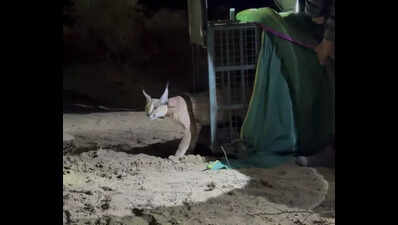
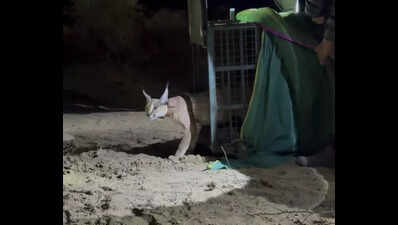
Jaipur/Jaisalmer: Elusive and endangered wild cat caracal will finally reveal its trail after forest officials in Jaisalmer radio-collared the feline for the first time in India in a four-day rescue operation that concluded Monday night.The operation, said to be a conservation breakthrough, began late Friday night following reports that the cat had been ensnared in a leg trap allegedly set by local poachers in Ghotaru village, adjacent to the Shahgarh gram panchayat in the Jaisalmer border area. Swift action by a special forest team led to the safe rescue of the animal.Led by Jodhpur chief conservator of forests (CCF) Anoop KR, the forest department and Wildlife Institute of India (WII) were involved in the collaborative effort to radio collar the male caracal and release it back into the wild.“Information on caracal in India remains scanty due to its secretive and largely nocturnal behaviour,” Anoop told TOI. “To address this gap, the department decided to monitor the rescued animal using a radio collar to study its movements and behaviour in the wild,” he said.The collar, provided by Dr Bilal Habib of WII, transmits location data every four hours and emits very high frequency (VHF) signals that can be detected within a 5-km range. “After it was released, it killed a goat,” said a senior forest official.State forest minister Sanjay Sharma called it a “significant conservation achievement” in a post on X.“This is the first time a caracal has been radio-collared in the country. It marks a major conservation milestone, and will help researchers assess the species’ population in the Thar desert, where sightings were reported recently. Over the past decade, we have only recorded around 350 camera-trap captures in Dholpur, Karauli and Ranthambore regions,” said conservationist Dharmendra Khandal, author of ‘Caracal: An Intimate History of a Mysterious Cat’.The tracking is spearheaded by assistant conservator of forests (ACF) Ranjit Singh Dholia of Indira Gandhi Nahar Project (IGNP), Jaisalmer, alongwith WII scientists Dr Sutirtha Dutta, Dr Moibuddin, and Dr Tushna Karkaria. They will monitor the animal’s movements closely.Senior forest officials acknowledged the challenge of protecting the species, with wildlife biologist Dr Sumit Dookia emphasising the necessity of safeguarding their natural habitat. “The Ghotaru landscape is a known caracal habitat. The species prefers bushy terrain and hunts at night, making sightings rare. Protecting its fragile habitat from pressures such as large solar projects is crucial” he said.